

If you work in mVAS, you probably think of carrier billing as a way to sell games, streaming, and dating subscriptions. That was true five years ago. In 2026, the picture is changing fast.
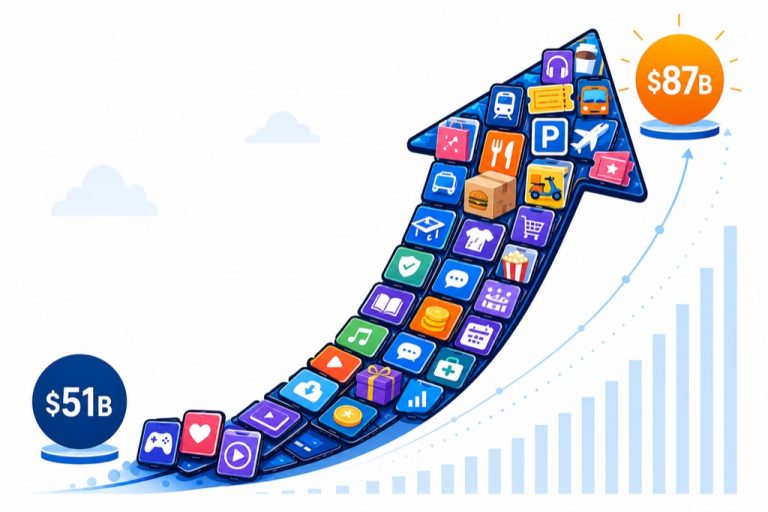
Juniper Research forecasts that global DCB transaction value will grow from $51 billion in 2026 to over $87 billion by 2030 — a $35 billion jump in four years. The driver is not more app-store purchases. It is a wave of new use cases: physical goods, transport ticketing, parking, food delivery, and even highway tolls.
For affiliates, this is not just industry trivia. Every new vertical that adopts carrier billing creates a new category of offers — and a new revenue stream.
What Is Actually Happening
Carrier billing has always had a regulatory ceiling. In the EU, the Payment Services Directive (PSD2) restricted DCB to digital content. In most markets, per-transaction and monthly spending caps kept it in the micro-payment zone.
That is changing on three fronts:
1. Regulation Is Opening Up
The EU’s PSD3 and Payment Services Regulation (PSR) — finalized in April 2026, expected to apply by H1 2028 — raise the limits:
- Single transaction cap: €60 (was €50)
- Monthly cumulative cap: €360 (was €300)
More importantly, aggregators like DIMOCO and Boku are using the Agent Model and e-money licenses to legally process physical goods payments through carrier billing today — without waiting for PSD3. A license is no guarantee on its own, though. Our case documentation shows the gap between holding an e-money license and actually honoring withdrawals.
DIMOCO rolled out carrier billing for Deutsche Telekom’s online shop in March 2025, handling physical goods via the Agent Model. Boku obtained an FCA e-money license that allows it to process any type of purchase — physical or digital — across the EU.
2. Real-World Deployments Are Live
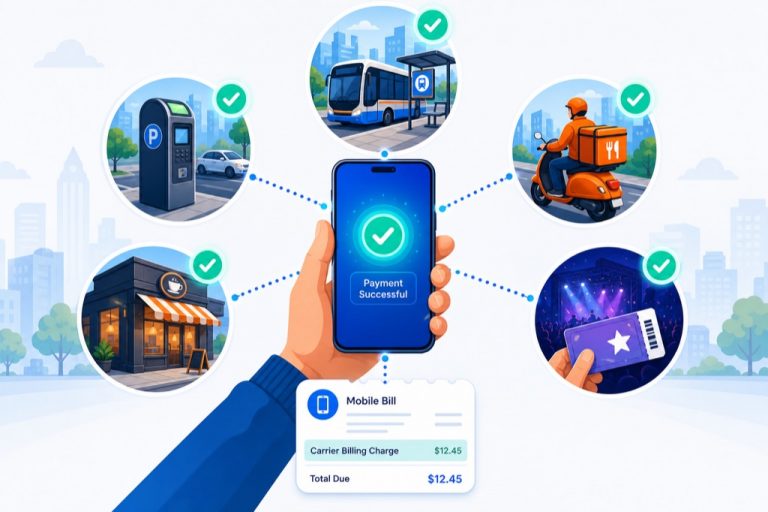
This is not theory. Carrier billing is already processing payments for physical-world services in multiple markets:
Transport and Mobility
- Germany (Bonn): SWB Bus und Bahn uses “Zahl einfach per Handyrechnung” for in-app ticket sales. Carrier billing is now the most popular payment method for occasional riders.
- Germany: m8mit parking app — carrier billing accounts for 28% of ad hoc charging sessions.
- UK: Boku partnered with O2, EE, and Vodafone for transit ticket purchases via the Corethree MoBus app.
- Turkey: Football match and concert tickets can be purchased via mobile bill.
- USA (Texas): Highway toll charges billed directly to mobile accounts.
Physical Goods and Food
- UK: IPC Media sells physical magazine subscriptions via carrier billing.
- UK: Boku’s click-and-collect service — order coffee or takeaway food, pay via phone bill, pick up at the store.
- Latin America: Centili partnered with three major operators to integrate carrier billing into ride-hailing and food-delivery super-apps, piloting high-frequency micro-transaction billing.
- DIMOCO + Deutsche Telekom: Physical goods in the operator’s online shop, processed through the Agent Model.
On average, adding carrier billing as a payment option has led to a 10% uplift in sales for mobility merchants, according to industry data from the Payments Industry Intelligence report.
3. The Numbers Are Stacking Up
According to Juniper Research and Tpay Mobile’s industry analysis:
- Spending on physical goods via carrier billing is growing 270% faster than digital goods spending over four years.
- The physical goods segment is projected to reach $25.4 billion by 2027, accounting for 21% of the global carrier billing market.
- DCB converts 7–10x better than credit cards as an onboarding payment method — merchants use it to acquire customers who later migrate to other payment options.
The conversion advantage makes sense: no card number, no registration, no app download. The user enters a phone number, confirms via SMS or PIN, and the charge appears on their mobile bill. For occasional or first-time buyers, this is the lowest friction path to purchase.
Why This Matters for Affiliates
If you are running mVAS campaigns today, this expansion changes the landscape in three concrete ways:
New Offer Categories Are Coming
CPA networks that specialize in carrier billing will start listing offers beyond games, dating, and streaming. Watch for:
- Transport and ticketing — CPA/CPI for transit apps that use DCB checkout
- Food delivery — CPS (cost per sale) for DCB-enabled food orders in emerging markets
- Parking and mobility — CPL (cost per lead) for parking apps integrating carrier billing
- Physical e-commerce — CPA for cross-border e-commerce merchants using DCB to onboard mobile-first customers
Juniper Research specifically recommends targeting cross-border e-commerce vendors for DCB partnerships, given their need to quickly onboard localized payment methods in new markets.
Higher Transaction Values = Potentially Higher Payouts
Traditional mVAS offers sit in the $0.50–$5.00 payout range per conversion. Physical goods and transport have higher basket values. As PSD3 raises the ceiling to €60 per transaction and €360 per month, the economics shift upward.
Boku’s own data shows average physical-goods transactions in the £2–£30 range in the UK. That is 3–10x the value of a typical mVAS subscription charge — which means room for higher affiliate payouts.
More DCB Users = Better mVAS Conversion Overall
Every person who pays for a bus ticket or parking via carrier billing becomes comfortable with the payment method. They understand the flow: phone number → confirmation → charge on bill.
When that same user encounters a mVAS subscription offer, the conversion barrier drops. They have already done this before. The broader DCB adoption gets, the larger the pool of users who are pre-qualified for mVAS offers.
The Technology Stack Behind the Expansion
Three technical developments are making physical-world DCB possible at scale:
GSMA CAMARA APIs
The CAMARA Carrier Billing Checkout API (v0.5.0) standardizes DCB payments across operators globally through the Open Gateway initiative. For merchants, this means one integration covers multiple operators and markets — instead of building custom connections for every carrier.
47+ telecom groups have joined Open Gateway. First Orion’s Global Exchange platform (launched April 2026) is among the first to adopt CAMARA-standard APIs, with connectivity across Germany, UK, Netherlands, Belgium, Spain, Italy, plus Middle East, Africa, and Asia.
Agent Model
The Agent Model is a legal and technical framework that allows a licensed payment intermediary to process DCB payments for physical goods on behalf of the merchant. DIMOCO has been the pioneer here, deploying it with Deutsche Telekom and other operators.
For affiliates, the Agent Model is important because it removes the regulatory blocker. Merchants can accept carrier billing for physical products today — they do not need to wait for PSD3.
5G and IoT Micro-Payments
Connected devices — wearables, smart TVs, cars — are starting to initiate carrier-billed payments. A smart TV subscribing to a streaming service, a car paying for parking, a wearable buying a transit ticket — all charged to the mobile bill.
This is early-stage, but the infrastructure is being built. The intersection of 5G connectivity and DCB creates a new category of automated micro-transactions that do not require a human to pull out a phone or enter a card number.
Key Players to Watch
| Company | Role | What They Are Doing |
|---|---|---|
| Boku | Payment platform | FY25: revenue +30%, bundling +71%, LPM +150%. E-money license enables physical goods. Expanding into retail, cable, financial institutions. |
| DIMOCO | Carrier billing provider | Agent Model for physical goods with Deutsche Telekom. SDK integration for mobility merchants. |
| Centili | DCB engine | 280+ operators. Piloting carrier billing in ride-hailing and food-delivery in LATAM. |
| Digital Virgo | DCB platform | Expanding in Africa (Chad via Moov Africa). DCB state-of-the-industry reports. |
| Tpay Mobile | DCB aggregator | MENA focus. CEO predicts physical goods as “the segment to watch.” |
What Affiliates Should Do Now
- Watch LATAM and MENA. Super-app ecosystems in Brazil, Mexico, Saudi Arabia, and Egypt are natural fits for DCB-powered food delivery and transport. Low card penetration + high mobile usage = carrier billing sweet spot.
- Learn the Agent Model. If you work with European GEOs, understanding how the Agent Model enables physical-goods billing gives you an edge. You can pitch advertisers on DCB integration and position yourself as a knowledgeable partner.
- Track PSD3 implementation. The regulation applies ~21 months after publication (expected H1 2028). The higher limits (€60/transaction, €360/month) will unlock new offer types in EU markets.
- Think beyond subscriptions. mVAS has been synonym for recurring subscriptions. The next wave of carrier billing includes one-time purchases (tickets, food, goods). Your campaign setup, creatives, and funnels will need to adapt.
The Bottom Line
Carrier billing started as a way to buy ringtones. Then it powered mobile games, streaming, and dating subscriptions. Now it is entering the physical world — transport, parking, food, e-commerce.
The market is growing from $51 billion to $87 billion by 2030. Physical goods spending is the fastest-rising segment — up 270% over four years. Regulation is catching up (PSD3), technology is ready (CAMARA, Agent Model), and real deployments are live in Germany, UK, Turkey, LATAM, and beyond.
For affiliates, this means one thing: the carrier billing ecosystem you already know is about to get much bigger. New offer types, higher transaction values, and more users comfortable with paying via their phone bill. The affiliates who understand these changes early will be first in line when the offers hit the dashboards.
Ready to explore mVAS and carrier billing offers across 50+ GEOs? Sign up with Affiliate Dragons and get dedicated support from managers who understand the DCB ecosystem inside out.