

Latin America has quietly become one of the most promising regions for mobile Value-Added Services. With 73% smartphone penetration, over 45% of adults still unbanked, and a Direct Carrier Billing market projected to grow from $48.5 billion to $128.4 billion by 2032 in Brazil alone, the opportunity is massive — and still largely untapped by affiliate marketers.
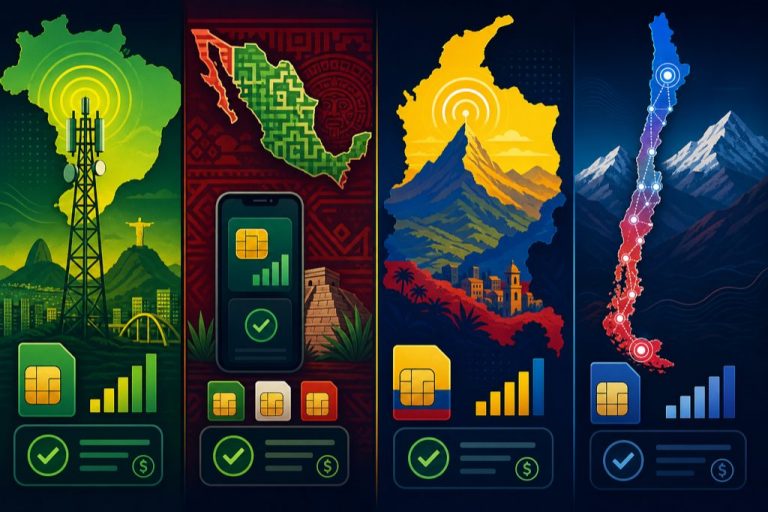
This playbook covers the four key LATAM markets for mVAS in 2026: Brazil, Mexico, Colombia, and Chile. For each country, we break down the operator landscape, dominant billing flows, realistic payouts, and what you need to know before launching campaigns.
Why LATAM Matters for mVAS Right Now
Latin America is the world’s second-fastest growing mobile region after Sub-Saharan Africa. The fundamentals for carrier billing are strong:
- 276 million mobile subscribers in Brazil alone (Anatel, May 2026)
- 73% smartphone penetration across the region, with Brazil hitting 85%
- 45% of adults unbanked — credit cards are not an option for nearly half the population
- DCB market CAGR of 12.8–14.7% through 2032, outpacing global averages
- Aggregators like Boku, Centili, and Fortumo actively expanding carrier integrations in the region
Unlike Africa, where infrastructure gaps can limit scale, LATAM offers solid 4G/5G coverage in urban areas combined with the payment gap that makes DCB essential. Unlike Southeast Asia, competition among affiliates is still relatively low — most media buyers have not explored LATAM mVAS beyond surface-level tests.
The region is also undergoing major telecom consolidation. Telefónica is exiting multiple LATAM markets (Argentina, Chile, Colombia, Peru), and Millicom (Tigo) is acquiring operations aggressively. This reshuffling creates both new carrier billing integrations and temporary disruptions that informed affiliates can navigate.
Brazil — The Continental Giant
Brazil is the largest mobile market in Latin America by a wide margin. With over 276 million active mobile lines, three dominant operators, and a population that transacts on smartphones first, it is the anchor market for any LATAM mVAS strategy.
Operator Landscape
| Operator | Market Share (May 2026) | Subscribers | DCB Status |
|---|---|---|---|
| Vivo (Telefónica) | 37.9% | 104.7M | Active — 2-click, PIN |
| Claro (América Móvil) | 33.2% | 91.7M | Active — 2-click, PIN |
| TIM | 22.4% | 62.0M | Active — 2-click |
Source: Anatel / teleco.com.br, May 2026
Billing Flows
2-click is the dominant flow for mVAS in Brazil. The user lands on the offer page and confirms the subscription with two taps — no PIN entry required. This provides high conversion rates but is directly affected by the Chrome HTTPS-by-default transition since 2-click relies on header enrichment for subscriber identification.
PIN submit is growing as operators prepare for the post-HTTPS world. Claro Brazil is among the operators testing GSMA Number Verify as a replacement for header enrichment. Affiliates running PIN submit flows in Brazil are future-proofing their campaigns.
PIX vs. DCB
Brazil’s instant payment system PIX processed 70% of all banking transactions in 2024 and continues to grow. However, PIX and DCB serve different purposes. PIX dominates peer-to-peer transfers and e-commerce checkout. DCB wins in impulse micro-subscriptions — content, games, streaming — where users don’t want to open a banking app or enter credentials. The two payment methods coexist rather than compete. Whichever rail you use, the provider behind it matters: we documented what happens when a payment provider stops processing withdrawals.
What to Expect
- Payouts: $0.15–$0.50 per subscription (varies by operator and content type)
- Best content types: Games, entertainment portals, streaming, horoscopes
- Traffic cost: CPM on push starts at ~$0.05–0.10; pop traffic widely available
- Key risk: Chrome HTTPS rollout (October 2026 for all users) will impact 2-click flows
Mexico — Where 1-Click Still Lives
Mexico is unique in the LATAM mVAS landscape for one reason: Telcel, the dominant operator, still supports 1-click billing flows. In a world where most carriers have moved to 2-click or PIN submit under regulatory pressure, this makes Mexico a high-conversion environment — for now.
Operator Landscape
| Operator | Market Share | DCB Status |
|---|---|---|
| Telcel (América Móvil) | ~50% | Active — 1-click, 2-click |
| AT&T México | ~22% | Active — 2-click, PIN |
| Movistar (Telefónica) | ~15% | Limited DCB |
The SIM Registration Factor
Mexico’s Commission for the Regulation of Telecommunications (CRT) introduced mandatory mobile line registration in 2026. All prepaid and postpaid lines must be linked to a user’s identity through a phased calendar:
- Lines ending in 0: by August 15
- Lines ending in 1: by August 31
- Progressive deadlines through December 31 (lines ending in 9)
Unregistered lines face suspension 72 hours after their deadline. This is important for affiliates because prepaid subscribers — the core mVAS audience — may experience temporary service disruptions during Q3–Q4 2026. Monitor conversion rates closely during this period and be ready to shift budgets between operators.
Billing Flows
1-click on Telcel remains the highest-converting flow in LATAM. The user clicks once, the subscription is confirmed via header enrichment, and the charge appears on their next bill. No PIN, no second confirmation. However, this flow is at risk from both HTTPS changes and potential regulatory tightening.
PIN submit is the standard for AT&T México and is becoming more common on Telcel for certain content types.
What to Expect
- Payouts: $0.40–$1.75 per subscription (Telcel offers tend to pay higher)
- Best content types: Sweepstakes, games, celebrity content, entertainment
- ISP targeting: Always target by carrier (Telcel vs. AT&T) — different flows, different payouts
- Key risk: SIM registration deadlines (Aug–Dec 2026) may reduce prepaid conversion volume
Colombia — Claro’s Kingdom
Colombia is a market defined by one dominant player. Claro (América Móvil) controls over half the mobile market and most of the carrier billing infrastructure. The recent Millicom–Movistar merger is creating a scaled challenger, but Claro remains the primary target for mVAS campaigns.
Operator Landscape
| Operator | Market Share | Subscribers | DCB Status |
|---|---|---|---|
| Claro | 50.4% | ~30M | Active — 2-click, PIN |
| Tigo-Movistar (Millicom) | ~36% | ~23M | Active — 2-click, PIN (integrating) |
| WOM | ~5% | ~3M | Limited |
A major shift happened in February 2026: Millicom completed its $214.4 million acquisition of Telefónica’s stake in Movistar Colombia. The combined Tigo-Movistar entity now controls 35–40% of subscriber lines. For affiliates, this means carrier billing integrations on the Movistar side may be in flux during the merger integration period.
Billing Flows
2-click is the standard on Claro Colombia. PIN submit is available but less common. The country has 76% smartphone penetration and a growing mobile wallet ecosystem (Nequi, Daviplata), but DCB remains the preferred method for digital content subscriptions.
What to Expect
- Payouts: $0.20–$0.80 per subscription
- Best content types: Entertainment packages, games, streaming portals
- Key opportunity: Claro’s dominance means one carrier integration covers half the market
- Key risk: Tigo-Movistar merger may temporarily disrupt billing on Movistar lines
Chile — The Lab Market
Chile is the smallest of the four markets by subscriber count but the most interesting for testing. It has strong digital infrastructure, high mobile penetration, and an operator landscape that is being reshaped by Telefónica’s exit.
Operator Landscape
| Operator | Market Share (Q1 2026) | DCB Status |
|---|---|---|
| Entel | 34.2% | Active — 2-click (Bango/Google Play DCB) |
| Movistar (→ Millicom) | 23.1% | Active — 2-click (transitioning) |
| Claro-VTR | 21.3% | Active — 2-click |
| WOM | 20.5% | Limited (Chapter 11 restructuring) |
Chile’s operator landscape is in motion. Entel leads with 34.2% and is actively expanding DCB — Bango enabled carrier billing on Google Play for Entel subscribers, and Entel is investing $286 million in 5G infrastructure. Movistar Chile was sold to a consortium led by Millicom and NJJ Holding for $1.2 billion in February 2026, continuing Telefónica’s LATAM exit. WOM filed Chapter 11, which limits its commercial activity and pushes subscribers toward Entel and Claro.
Meanwhile, Claro is gaining ground in number portability — it posted the best net balance of customer migration in Q1 2026, positioning itself as the number-two mobile operator ahead of Movistar. Chile also has a cautionary side on the advertiser end — we documented unpaid invoices from a Chilean mVAS advertiser after months of confirmed traffic reports.
Billing Flows
2-click dominates on both Claro and Entel. Chile is a good market to test new creatives and landing pages before scaling to Brazil, since traffic volumes are manageable and the audience is digitally savvy.
What to Expect
- Payouts: $0.20–$0.50 per subscription
- Best content types: Games, entertainment, quizzes, horoscopes
- Key opportunity: High digital literacy + operator competition = good CR for quality traffic
- Key risk: Movistar transition to Millicom ownership may disrupt existing billing integrations

Traffic Sources That Work for LATAM mVAS
Choosing the right traffic source is critical in LATAM. The region has distinct characteristics that favor certain ad formats over others.
Push Notifications
Push remains the go-to format for mVAS in LATAM. Low CPCs ($0.003–$0.01 depending on GEO), real opted-in users, and the ability to target by mobile ISP make push ideal for carrier billing offers. The key networks for LATAM push traffic include PropellerAds, RichAds, Adsterra, and ROIAds.
Critical targeting settings for mVAS push campaigns in LATAM:
- Platform: Mobile only
- OS: Android
- Browser: Chrome, Samsung Browser
- Connection: 3G/LTE (not WiFi — you need carrier-identified traffic)
- ISP: Target specific operators (Telcel, Claro, Entel, etc.)
Pop Traffic
Popunder ads deliver massive volume at rock-bottom prices in LATAM. Conversion rates are lower than push, but the scale compensates. Use aggressive pre-landers to warm up cold pop traffic before sending users to the subscription landing page.
Google Ads & Meta Ads
For affiliates with experience in mainstream traffic sources, Google Ads and Meta (Facebook) Ads offer unmatched targeting precision in LATAM. Lookalike audiences on Meta are particularly effective for scaling winning mVAS campaigns to new GEOs. However, moderation is stricter — landing pages must be fully compliant with carrier and platform policies.
Budget Recommendations
- Starting test: $100–200 per GEO
- Format: Begin with push, validate the offer, then expand to pop and paid social
- Optimization: Use a tracker (Keitaro, Binom) to blacklist underperforming placements after the first 48 hours
- Scaling: Once profitable, increase budgets by 20–30% daily while monitoring CR and carrier approval rates
LATAM-Specific Challenges and Tips
The HTTPS Transition
Chrome’s HTTPS-by-default rollout is the single biggest technical risk for LATAM mVAS in H2 2026. Chrome 147 (April 2026) already affected Enhanced Safe Browsing users (~1 billion globally). Chrome 154 (October 2026) will extend this to all Chrome users, effectively ending HTTP header enrichment for subscriber identification.
Impact varies by market:
- Brazil: Operators preparing Number Verify deployments; expect 2-click CR drops of 30–50% before recovery
- Mexico: Telcel’s 1-click flow is most at risk; PIN submit offers are the safe bet
- Colombia & Chile: 2-click flows affected; operators with GSMA Open Gateway adoption will recover fastest
Industry analysts consider this a short-term disruption rather than a structural threat — the technology to replace header enrichment exists and is being deployed. But affiliates should diversify toward PIN submit flows now rather than waiting for October.
Localization Matters
LATAM is not one market. Portuguese in Brazil is different from Spanish in Mexico, which is different from Spanish in Colombia or Chile. Landing pages must be localized for each country:
- PT-BR ≠ PT-PT — Brazilian Portuguese has distinct vocabulary and tone
- ES-MX ≠ ES-CO ≠ ES-CL — Mexican, Colombian, and Chilean Spanish differ in slang, formality, and even number formatting
- Use local currency symbols and pricing conventions (R$ for Brazil, $ for Mexico/Colombia/Chile)
Telecom Consolidation
Telefónica’s exit from LATAM is creating a wave of operator transitions. Millicom acquired Movistar operations in both Colombia ($214.4M) and Chile ($1.2B) in early 2026. During integration periods, carrier billing APIs may change, approval processes may slow down, and some offers may go offline temporarily. Work with your CPA network manager to stay ahead of these changes.
Getting Started with LATAM mVAS
Here is a practical launch sequence for affiliates new to the region:
- Pick one country. Brazil for volume, Mexico for high payouts (1-click Telcel), Chile for testing, Colombia for Claro-focused simplicity.
- Choose 3–5 offers targeting the dominant operator in that country. Ask your network manager which offers have the best current approval rates.
- Launch with push traffic. Set up ISP-level targeting, Android-only, 3G/LTE connection. Budget $100–150 for the initial test.
- Optimize after 48 hours. Cut losing placements, double down on winning creatives, test new angles.
- Expand to the next GEO once you have a profitable campaign. Your winning creatives from one LATAM country often translate well to another (with proper localization).
Latin America’s mVAS market is growing fast, the operator infrastructure is maturing, and affiliate competition remains low compared to Africa or Southeast Asia. The window of opportunity is open — especially for affiliates who understand the carrier landscape and move before the HTTPS transition reshapes the playing field.
Ready to start? Sign up with Affiliate Dragons and get access to mVAS offers across Brazil, Mexico, Colombia, Chile, and 50+ other GEOs — with direct carrier relationships, real-time tracking, and dedicated affiliate managers.