

“The Reset”
Telemedia Marbella ran 4–6 October 2026 at the Hard Rock Hotel, and the organisers called the conference programme “The Reset”. That turned out not to be marketing language. Twelve sessions across two days, structured around the real flow of the industry — traffic, journeys, payments, intelligence, content, growth — and almost every one of them came back to the same problem.
Two weeks before the conference, on 22 September 2026, Google shipped Chrome 154 with “Always Use Secure Connections” enabled by default for public sites. The release notes call it “Ask before HTTP on by default”. One curious detail: Google announced this version for October a year earlier, but Chrome moved from a four-week release cycle to a two-week one in the autumn, so 154 arrived a month early. Part of the industry is still waiting for a change that is already in production.
We did not travel empty-handed. We brought our own product: Univeome, our new mobile video portal built on original animation that we write, produce and voice ourselves. That noticeably changes the kind of conversations you have. When you are a content owner as well as a traffic partner, you discuss retention and catalogue rights with operators and aggregators, not just the rate per subscription. More on that below.
Here are six things worth your attention — plus the takeaways of our manager, who spent all three days in the room.
1. Header Enrichment Still Works — but the Window Is Closing
Let us defuse the panic that was plentiful at the conference. Header enrichment has not been switched off, and your funnels are most likely still converting. If you are looking at your stats right now and seeing that auto-identification is alive, that is not a measurement error. That is how it should be.
Here is what Chrome actually did: it attempts HTTPS, and when an HTTP step is unavoidable it shows a warning with the option to continue. This is a prompt, not a block. And it only asks on the first or a rare visit to an insecure site, not on every navigation — Google deliberately designed it so that regularly visited HTTP resources do not nag the user constantly. The setting can also be turned off in Chrome’s security settings, and for anyone who had previously configured it by hand, Chrome preserved their earlier choice.
More important for our industry: Android WebView is not affected by this change. HTTPS-First Mode lives in Chrome’s own code, and in the Intent to Ship the Chromium team stated plainly that the functionality is not available for WebView and is considered at most a future opt-in for the embedding application. All traffic from in-app browsers inside social apps runs through WebView and will not see the warning. Chrome Custom Tabs run on Chrome’s own engine, so behaviour there will in all likelihood be browser-like — but that is worth verifying on your own funnels.
Add the usual inertia on top: the rollout comes in waves, and Chrome updates on Android stretch across weeks. We covered the mechanics of the transition and the preparation options back in March, when Google first announced the dates.
So the honest picture looks like this. This is a gradual squeeze, not a kill switch. The share of your audience that hits a warning mid-payment is small today, but it will grow steadily — and grow quietly, because from the outside it is not an error, just a sagging conversion rate at one particular step. The consequences are not limited to payment either: redirects, attribution and affiliate tracking degrade in the same place.
The tactical conclusion is simple. You have more time than the stage suggested, but the direction is irreversible. The sensible move is to measure your exposure — what share of your conversions arrives from full Chrome versus WebView — and build your replacement around that number rather than around general anxiety.
The most valuable correction came from Amine Ennajih of Telenity. He pushed back on framing this as “Google created a crisis for us”. In several Middle Eastern markets header enrichment was restricted years ago, after fraud and traffic injection problems. Business continued there. The first response was SMS OTP verification: more friction, but also a real record of user consent, which turns out to be very useful once disputes begin.
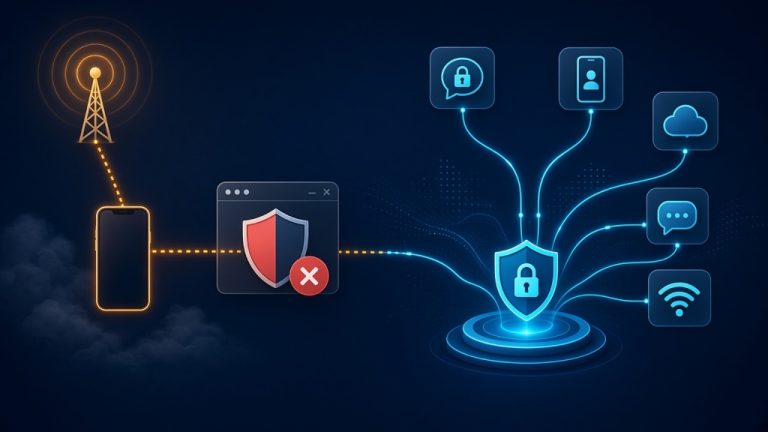
The replacement options discussed, roughly in order of actual readiness:
- SMS OTP — works today, proven in MENA, costs you conversion rate.
- Operator APIs and phone number verification (PNV) — restores silent identification without asking the user to copy a code. This is exactly the infrastructure GSMA Open Gateway is building.
- Firebase Authentication — Frode André Alvad of Telenor Linx walked through the approach, but the live demo did not happen: changes on Google’s side got in the way. This is a direction of development, not a finished solution.
- DCB over RCS — Frank-J Arnold of mobile business engine presented this as a genuinely Chrome-proof rail that doubles as a new acquisition surface.
Nobody on stage claimed a universal out-of-the-box fix. The roadmap language was “rebuild for Q1 2027”.
And here is a thought that did not land immediately at the conference but reached its clearest form in Telemedia’s editorial round-up: the potential of these solutions is wider than patching the hole left by the HTTP step. RCS journeys and secure phone number verification do not merely restore convenience — they also improve identification and purchase awareness, open up the Wi-Fi audience that header enrichment could never reach, and tie payment, content delivery and support into a single loop. In other words, a forced rebuild is also a chance to capture traffic you simply could not monetise before.
What this means for you: if your funnels still rest on auto-identification, the fallback needs testing before your conversion chart tells you about the problem.
2. Cheap Traffic Became the Most Expensive Line Item
The opening session was called Cheap Traffic, Expensive Lessons, with panellists from Mesh Ads, MCP Insight and Google. The thesis: mobile growth is now determined by traffic quality rather than volume, and cheap sources hide their true cost. Weak signals at the entry point turn into chargebacks, disputes and operator attention sixty to ninety days later — noticeably after the campaign looked profitable on the dashboard.
“Just looking at CPA and cheap acquisition is not enough anymore,” Christopher Henseler of Mesh told delegates. And he added the part that stings more: even tracking the first successful billing, something Mesh had long encouraged partners to do, no longer reflects the full picture. Whether a campaign is building a viable business can only be established through renewals, churn, complaints, refunds and actual content usage.
The practical takeaway was about quality scoring before scale, not fraud cleanup afterwards. Read early signals, assess sources against future lifetime value, and treat funnel fragility as a metric you genuinely track. Operators are doing exactly this on their side: their assessment of your traffic risk increasingly determines whether you get a good rate and whether you keep it.
The AI Warning Worth Reading Twice
The most valuable part of the session was not the call to “feed data back into campaigns” — it was the caveat attached to it.
A user who did not pay because the billing broke is not a poor acquisition. Feed that outcome into an advertising algorithm without understanding the cause and things get worse: the algorithm starts avoiding perfectly good audiences and optimising around an artefact of your own technical problem.
Hence the conclusion Telemedia’s editorial drew: data quality is not limited by tools but by coordination between merchant, agency, aggregator and operator. As long as nobody in that chain can distinguish a failed charge from a deliberate cancellation, automation will amplify the error rather than correct it.
Separately, Francesco Beninato of Google discussed the move to Demand Gen in place of Display and advised testing early rather than waiting for a forced migration — with the caveat that Google’s plans remain dynamic.
3. Fraud Moved to Identity and Behaviour
The New Fraud Frontier session covered the shift away from the patterns most blacklists were written for, towards attacks at the identity level: synthetic users, device behavioural anomalies, click injection. Static rules do not catch these.
The weightiest supporting evidence was the case of Evina and Libyan master aggregator Ebtekar, presented at the event. Libya built fraud protection into its DCB ecosystem from day one rather than bolting it on afterwards. The stated results: every monitored payment journey compliant with applicable regulation, more than 99.94% of fraud attempts blocked on the payment page itself, and every transaction analysed in under 100 milliseconds.
But a different number is the telling one. According to an Evina study from August 2026, Libya has five times less inauthentic traffic than other major MENA markets. That is not a detection story, it is a deterrence story: fraudsters stopped trying because the return does not justify the effort.
4. Subscriptions: Stop Optimising for the Sign-Up
The Subscription 2.0 session brought together Kilian Espana (Overdrive Digital), Jennifer Courtney (Google), Laurent Baquiast (Wister) and Smitha Mathew (Aurora Digital) — and it was the most immediately applicable block of the whole conference.
Espana’s point: stop reporting acquisition volume. Feed back data on who is still subscribed at 30, 60 and 90 days and how much revenue they generated. Break that down by placement, device and creative and it becomes visible which campaigns buy customers and which buy sign-ups. Overdrive already runs value-based bidding and target ROAS wherever the client can supply the necessary data.
The second half, from Courtney, was about plumbing: connecting first-party data, on-site measurement, APIs and customer systems so that campaigns can see the full subscriber journey, and passing value back in.
One distinction came up repeatedly and deserves its own line in your reporting: technical churn is not voluntary cancellation. A failed renewal and a user who decided to leave are different problems with different fixes, and averaging them together hides both.
Smitha Mathew of Aurora Digital described a similar approach on a shorter horizon: when entering a new market they look at behaviour as early as day ten. Her main thesis is that the same funnel at the same price cannot simply be exported anywhere. European postpaid allows higher-priced, higher-quality selling; in Africa affordability decides; in mature Middle Eastern DCB markets there are different charging constraints and a different customer profile. These are observations from Aurora’s practice rather than a universal formula — but the conclusion from them is unambiguous: an acceptable acquisition cost is calculated from local pricing, billing performance and audience behaviour, not carried over from your previous market.
A fair complaint about the usual way of choosing a partner surfaced there too: asking an agency for “your best GEOs and cheapest CPA” is close to useless. Somebody else’s acquisition cost in the UAE tells you nothing about what you can afford.
The session’s closing frame: lasting subscriptions come out of the whole system — an honest advertisement, an affordably priced offer, a service that works, billing that succeeds, and evidence that helps the next campaign find similar people. Tools help. They do not substitute for a product worth keeping.
5. Where the Growth Actually Is
The second day was devoted to opportunity.
LATAM is moving from entertainment to digital utility — towards services that solve an everyday problem rather than fill time. Panellists from Renxo, Media Digital Group and Neaxis named hybrid bundles and service packs as the format gaining ground.
Africa was the most substantive block of the second day. Ghana, Nigeria and Morocco were named as the markets with momentum, and Jean-Noel Kouadio of Orange highlighted results in Morocco and Tunisia specifically. Smadex reported African ad spend on its platform rising almost 80% year on year. The new angle this year is consumer trust: clear pricing, relevant content and local-language support as growth drivers rather than compliance overhead. In acquisition, video and playable formats are pulling ahead; in content, short dramas.
But the main thing in the Africa session was not growth — it was the collection problem, and it affects everyone running on pure DCB. We have a separate market-by-market breakdown in our Kenya, Egypt and Nigeria playbook. Kouadio explained the mechanics: customers increasingly commit money to communication bundles, leaving less on the main balance. Wallets add another place where funds sit. Edgar Kra of Digital Virgo confirmed that the share of successful charges against the main balance continues to decline.
For a merchant on standalone DCB this looks like plenty of acquisitions and too few successful charges. The industry’s answer is bundling: combining the content and the means of consuming it into a single purchase. The conference described a construction where a merchant’s gaming service is sold together with data allocated to its use, assembled by the operator from its own understanding of how the network is actually used.
The editorial round-up puts it like this: persistently trying to charge an empty balance is not a solution. The winning proposition might be a subscription, a wallet purchase, a few hours of access, or a service tied to a data bundle. The job is to work out which combination the audience understands, can afford and wants to keep renewing.
Gaming 3.0 was framed around retention rather than acquisition: engagement loops, well-judged difficulty curves, retention without leaning on licensed IP.
The closing panel was about MENA 2027. The conflict froze operator approvals and new launches and tightened payment flows, but demand never went away. The industry is preparing for a reset and a full return to Dubai in 2027.
6. Payment Choice: DCB Stays, but Stops Being the Only One
Put the Africa session, the new rails panel and the editorial round-up together and one shared conclusion emerges. DCB is not going anywhere and remains the central instrument — but it copes less and less well on its own, because the user’s money physically sits elsewhere.
Hence a practical recommendation nobody at the conference argued with: alongside DCB it makes sense to connect cards, local wallets and bundles, and in some markets to keep an eye on cryptocurrency. That last one is strictly keeping an eye for now — it was not presented on stage as a settled question, and it is too early to build a strategy on it. But as a direction worth watching, crypto came up regularly in corridor conversations.
The logic of choosing a rail is not “what is more modern” but “where this particular audience keeps its money”. In European postpaid that is a card. In Africa, a wallet or a data bundle — and we covered the scale of that shift in our piece on how telcos are becoming banks. In mature Middle Eastern DCB markets, still the operator. A multi-rail setup is needed not only for resilience against browser updates, although that too, but to stop losing already-acquired users at the charging step.
Four Takeaways From Our Manager
Damir represented us at the conference, and his own conclusions turned out to be close to what Telemedia’s editorial team arrived at a week later. We are presenting them as they came, in his own words.
The billing of the future is multi-currency. DCB alone is not enough: it is good when cards, local wallets and in some places cryptocurrency sit alongside it. The more ways to pay, the fewer acquired users you lose at the charging step.
Language adaptation for the specific region is the key advantage over competitors. Not interface translation but adaptation: local language in the content, in support, in the creatives. The Africa session called exactly this a driver of consumer trust, and Telemedia’s editorial team distilled it into the line that relevance is the industry’s advantage.
Quality relationships, built once, pay off for a long time. Marbella is deliberately designed as a relationship-led format, with eleven networking events against two days of talks. Deals are not closed here; the relationships that pay off over the following years are laid down here.
Think about the end user’s benefit and lifetime value follows. The simplest of the four takeaways and the one that coincides most with the conference’s central thesis. Telemedia’s editorial round-up is literally titled “telemedia has to earn the next payment”: cheap acquisition only makes sense when the user understood what they paid for, received what was promised and keeps paying. Payment technology does not compensate for a product people do not want.
What We Brought: Univeome
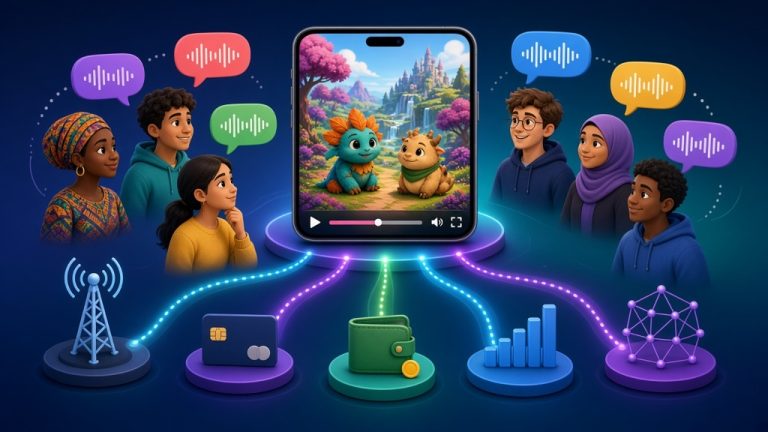
We did not travel only to listen. We came with Univeome — a mobile video portal built on animation we produce ourselves: our own scripts, our own production, our own voice work.
After two days in Marbella that decision looks different from how it looked when we made it.
Three recurring themes of the conference point in the same direction. The Africa panel argued that content relevance and local-language support drive sustainable growth. Subscription 2.0 came down to lifetime value depending on whether anything worth paying for is still there on day sixty. Both of those are catalogue problems before they are marketing problems.
Owning the IP changes the economics underneath them. There is no royalty layer eating the margin. There is no risk of a licensor pulling the catalogue and taking your retention curve with it. Localisation for a new market is a production decision we make ourselves, not a rights negotiation. And when an operator asks about content compliance — and they always ask now — the answer stops with us instead of travelling through three intermediaries.
Your Next 90 Days
A short checklist covering everything above:
- Calculate your Chrome exposure. What share of conversions arrives from full Chrome and Custom Tabs, and what share from in-app browser WebViews. The first number is your risk, and it will grow.
- Test live funnels on real devices under Chrome 154 and later. An emulator will not show you where the warning appears.
- Build and test a fallback identification path — OTP at minimum, and operator APIs or PNV if your partners support them.
- Rebuild subscription reporting around 30/60/90-day retention and revenue, broken down by placement, device and creative.
- Separate technical churn from voluntary cancellation in that reporting.
- Do not feed technical failures to the algorithm. A charge that failed because of billing should not enter the campaign as a “bad audience” signal.
- Add behavioural fraud screening instead of relying on source blacklists.
- Widen payment choice around DCB — cards, local wallets, bundles with data allowances, and A2A and Open Banking where appropriate. Look not at how fashionable a rail is but at where your audience actually keeps its money.
- Check the depth of your localisation. Language in the content, in support and in the creatives, not only in the interface — the conference called this one of the main competitive advantages.
The through-line of Marbella 2026: the industry is not repairing the old funnel. It is building a new one — and those who start now will have it running before those who wait.
Want to work with offers and traffic partners who are already rebuilding? Sign up with Affiliate Dragons.